Shaker Cabinets in White, Grey and Wood
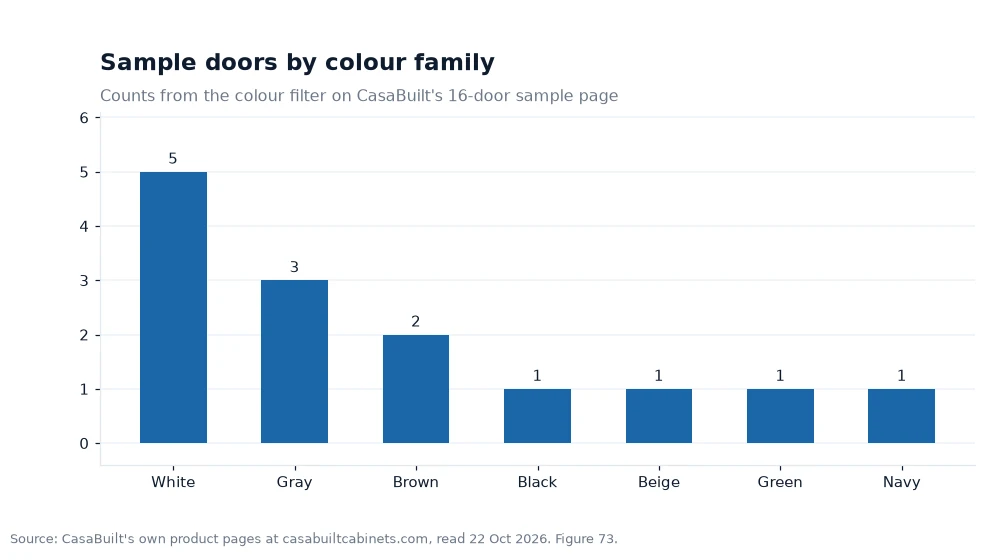
White, gray and wood-tone are the three finish families most kitchens land in, and CasaBuilt's sample range reflects that: five white doors, three gray and two brown out of 16, with single doors in black, beige, green and navy behind them. Each door is $9.99 and refundable with a cabinet purchase. The interesting question is not which looks best on day one but which still looks right after five winters of cooking.
Key takeaways
- Ten of the 16 sample doors are white, gray or brown; the remaining six cover four other colour families.
- White is the deepest group at 5 doors, or 31.25% of the range.
- Every door carries seven layers of paint with a UV protective finish.
- The published warranty is one year against manufacturing defects in materials and workmanship.
Three families, not seven colours
The sample page lists seven colour families, but they behave as three. White and gray are painted neutrals that reflect light and show marks. Brown is a wood tone that absorbs light and hides marks. Beige sits with the neutrals, while black, green and navy are accent colours that a household either commits to or ignores.
That grouping matters because the maintenance profile of a kitchen follows it. A painted white door shows a splash, a scuff and a greasy handprint. A mid-gray door shows dust along the bottom rail but forgives a splash. A wood-tone door shows neither, and instead shows the light itself, which is why oak-look kitchens photograph differently at four in the afternoon than at nine in the morning.
None of that makes one family better. It makes the choice a trade between brightness and tolerance. A small kitchen with one window usually wants the brightness. A large kitchen with a wall of glass can afford the tolerance, because it already has enough light without asking the cabinets to supply more.
The range in counts
The published distribution is uneven by design. White has five doors, gray three, brown two, and black, beige, green and navy have one each. That is 16 doors in total. The table converts each count into a share and adds the practical note a buyer needs before ordering samples in a given family.
| Colour family | Doors | Share of 16 | What the choice costs in upkeep |
|---|---|---|---|
| White | 5 | 31.25% | Brightest result; shows splashes and handprints first |
| Gray | 3 | 18.75% | Softer contrast; dust shows along the bottom rails |
| Brown | 2 | 12.5% | Wood tone; marks hide, but the finish dominates the room |
| Black | 1 | 6.25% | High contrast; every fingerprint shows in strong light |
| Beige | 1 | 6.25% | Warm neutral; the most forgiving of the pale finishes |
| Green | 1 | 6.25% | Committed colour; hard to match if a door is replaced later |
| Navy | 1 | 6.25% | Dark and glossy-looking under light; shows dust on flat panels |
The single-door families are the ones to sample carefully. A white kitchen has five candidates, so a buyer can compare shades and pick the warmest or coolest. A green kitchen has one candidate, and if it does not work in the room there is no second green to fall back on. Depth of range is part of what a buyer is choosing, not just colour.
White and gray: the painted middle
White and gray are the same finish with different pigment, and they age along the same lines. The published finish is seven layers of paint with a UV protective coat, applied over a rubberwood frame and an MDF panel. The UV layer is the part that faces daylight, and it is why a painted door is specified with more than a colour coat.
The practical difference between the two is contrast. A white door against a white wall disappears into the architecture, and the kitchen reads as a single bright volume. A gray door holds a line against the wall, so the run of cabinets becomes a visible object. In an open plan where the kitchen sits inside a larger room, that line is often the thing that makes the layout legible from the sofa.
Cleaning habits decide more than the shade card. A household that wipes the fronts weekly will be happy with white. A household that wipes them when guests come will be happier with gray, because a mid-tone loses a light film of dust that a white door holds. Neither finish resists a hot pan splatter; both need the wipe.
Wood tone and how a finish wears
Brown is the smallest of the three main families at two doors, but wood tone carries a different promise. It does not try to be a flat colour field; it shows grain, and grain is what makes a mark less visible. A scuff on a white door is a scuff. A scuff on a wood-tone door reads as part of the pattern until it is examined closely.
The trade-off is that wood tone sets the temperature of the room. A warm brown pulls the walls, the floor and the worktop toward it, and a cool white worktop can look stark beside it. The published oak-look option, Slim White Oak at $2,295.64 for the basic six-cabinet kitchen, is the top of the price range and the finish that most changes the character of a room. Buyers who want the wood look but not the price should compare it with Smokey Ash at $1,932.42, a painted door in a similar tonal family.
Whatever the family, the door should be judged under the room's own light before the order. The published shaker cabinets range lists all 16 doors on one page, and the Slim White Oak page is the place to check the specification behind the wood-tone option before committing to a warmer scheme.
Worked example: weighing the three families
Take the chart values in order: White 5, Gray 3, Brown 2, Black 1, Beige 1, Green 1, Navy 1. Add them: 5 + 3 + 2 + 1 + 1 + 1 + 1 = 16. As shares of 16, White is 31.25%, Gray is 18.75%, Brown is 12.5%, and the four single-door families are 6.25% each.
Now group them. The three main families are 5 + 3 + 2 = 10 doors, or 62.5% of the range. White and gray together are 5 + 3 = 8, exactly half. Painted doors, counting every family except Brown, are 16 - 2 = 14, or 87.5%. Price the neutrals at $9.99: five whites are $49.95, three grays are $29.97 and two browns are $19.98, so the ten-door neutral set is $99.90. Against the $1,199.50 White Shaker starter kitchen that is 8.3% of the price, and the whole fee returns with a cabinet purchase.
Frequently asked questions
Which colour family is easiest to keep clean?
Brown, because the grain breaks up the appearance of marks that a flat painted panel would show. Among the painted families, beige and gray sit between white and the dark colours. All of them need the same wipe after cooking; the difference is how visible a missed wipe becomes the next morning.
Is white the most common choice in the range?
By sample count, yes: five of the 16 doors are white, or 31.25%, against three gray and two brown. That depth means a buyer can compare warm and cool whites rather than accepting a single shade. The published White Shaker basic kitchen is $1,199.50 against a $2,399.00 list price.
How long does the painted finish last?
The spec sheet lists seven coats of paint plus a UV protective topcoat, and the warranty covers one year of manufacturing defects in materials and workmanship under normal residential use. That warranty says nothing about appearance over time, so treat the finish as something maintained rather than permanent: wipe splashes while they are fresh, and expect direct sun to be the hardest test the door faces.
Sample the family, then the shade
Order one door from each of the three main families and judge them on the floor in the room's own light. Then order a second door from whichever family wins, so the shade is compared against a sibling rather than against a different material. Ten doors cost $99.90 and the fee returns with the cabinets.
The finish a kitchen keeps is the one that survives its worst afternoon, not its best photograph. Choose the family for how it wears, and the shade for how it looks at seven in the evening.
Figures quoted here come from the manufacturer's own website, read 22 Oct 2026[1].